Student Profiles
GHAC Student Profiles
Each student has a personal story as to why they chose GHAC. Learn more about their unique lived experiences and motivations by reading their stories below.
Each student has a personal story as to why they chose GHAC. Learn more about their unique lived experiences and motivations by reading their stories below.

Raised on an American military base in Seoul, I grew up between two worlds—immersed in both Korean and American cultures, languages, and approaches to healthcare. This early exposure to universal healthcare systems, where access and prevention were prioritized, sparked my curiosity about how societies organize care and who gets left out when systems fail. My bicultural upbringing instilled in me a lifelong fascination with the intersections of identity, culture, and health, and how these factors shape the patient experience across borders.
Before medical school, I earned my undergraduate degree from UC Berkeley, where I spent years working closely with vulnerable communities affected by structural inequities—LGBTQ+ individuals, immigrants, and formerly incarcerated people. After graduation, I moved to San Francisco, where I conducted clinical trials for novel Long COVID treatments as a clinical research coordinator and further served the queer community by facilitating peer support groups for gay men living with HIV. These experiences deepened my understanding of how illnesses—including infectious diseases like COVID and HIV—disproportionately impact certain populations and regions around the world due to social, political, and systemic barriers to care. This perspective followed me to São Paulo, Brazil, where I spent a year working alongside activists to study barriers to sexual healthcare accessibility for transgender men.
I joined the Global Health Academic Concentration to build on my passions for global health research, cross-cultural collaboration, and accessibility. Advancements in medical research and treatments can save lives on a global scale, but only if they are designed and distributed equitably. As a future physician, I plan to pursue community-based research and advocacy that bridges public health and medicine, ensuring that the innovations we create reach the people who need them most.

During my PhD in ecology, I applied genomics and network modeling to study invasive species. While the experience deepened my love of research, it also revealed that I was missing a sense of purpose in my work. That realization led me to reflect on my earlier experiences in Puerto Rico , where, through an NSF Research Experience for Undergraduates program, I had examined how socioeconomic and environmental factors affected the spread of mosquito-borne illnesses such as dengue and Zika in the aftermath of Hurricane Maria.
The project revealed how structural and socioeconomic factors drive health outcomes. It also underscored the importance of community engagement. Working with local residents deepened that understanding: conversations exposed how gaps in education and infrastructure limited preventive efforts and how data alone cannot create change without collaboration and trust. These lessons were later echoed in my clinical experiences, where I saw how the same systemic forces influenced patient care on an individual level.
Together, these experiences informed my decision to pursue a career dedicated to advancing health equity by integrating research with clinical practice as a physician–scientist. Through GHAC, I hope to build on this foundation by gaining the skills and global perspective needed to develop evidence-based, sustainable, and community-guided approaches to address global health challenges.

My family moved to the Bay Area from Singapore when I was five. As a first-generation Indian American, I witnessed the intersection of culture, age, and health within my multigenerational household: seeing family members navigate chronic illness while balancing cultural expectations and structural barriers. These experiences shaped my early understanding that health extends far beyond diagnosis and sparked my interest in how cultural and social factors influence health.
In undergrad, to explore this perspective I joined an organization we implemented sustainable health and social projects designed with input from local contacts in our partner village in India. Speaking in Telugu and connecting with communities from my family’s home state, I saw firsthand how sociocultural factors shape health outcomes and care-seeking behaviors. These experiences reinforced the importance of community partnership, cultural awareness, and research in advancing equitable healthcare.
This interest evolved into a passion for designing engineering and medical interventions that are concordant with existing global healthcare disparities. Through the Global Health Academic Concentration (GHAC), I hope to build the framework to design equitable, culturally informed projects and strengthen the skills needed to integrate compassion, research, and global accessibility into every aspect of patient care.

As an undergraduate at UC San Diego, I pursued a minor in Global Health, which introduced me to the structural and social determinants that shape health outcomes worldwide. My volunteer work on both sides of the U.S.-Mexico border during undergrad, including Health Frontiers in Tijuana (HFiT) and the Migrant Shelter Clinic, deepened my commitment to expanding access to care for underserved populations. Through experiences working with migrant populations in San Diego and Tijuanna, assisting with cleft palate clinics in Tecate, and personal travels abroad, I gained invaluable insights into cultural frameworks of illness, resilience, and the complex narratives patients carry. These encounters sparked my passion for border health and instilled a sense of cultural humility that I hope to carry throughout my medical career.
As I began the medical school admissions process, I hoped more than anything that I could stay at UC San Diego and continue engaging with the diverse communities of San Diego that I’ve grown to care for deeply. GHAC supports a unique focus on engaging with underserved populations both within San Diego and abroad, through research, clinical rotations, and community-based electives like HFiT. Living in San Diego, I have loved working with Spanish-speaking communities and strengthening my own Spanish language skills. The electives and experiences offered by GHAC will help me to continue my involvement with Spanish speaking populations locally and internationally throughout my medical education. I look forward to learning how to collaborate with global partners and develop the tools necessary to become a compassionate, culturally informed physician with an emphasis on serving marginalized communities throughout my career.

Shortly after beginning my undergraduate studies at the University of Washington (UW), I was interested in pursuing a career in medicine. Through the Medical Laboratory Science Program, I developed an appreciation for the science and techniques underlying disease and diagnostics, while also searching for where I might best contribute to medicine.
After graduating, I had the privilege of working with UW physician-scientists, local healthcare professionals, and community leaders in Mombasa, Kenya at the Ganjoni Dispensary. There, I contributed to a maternal health study, a TB vaccine trial, and an ongoing 32-year cohort study of 600 active female sex worker participants living with HIV. I was inspired by the challenges and rewards of working across cultures to reduce disease burdens and improve health outcomes.
Motivated by this experience, I sought to bridge my laboratory training with my growing interest in infectious disease and global health equity research. I joined the Lund Lab at the Fred Hutchinson Cancer Center as a post-baccalaureate scholar, where I spent two and a half years investigating cervicovaginal immune alterations associated with bacterial vaginosis and herpes simplex virus-2 infection. These studies helped to uncover potential immune mechanisms contributing to increased HIV susceptibility, and I was fortunate to collaborate with colleagues in Kenya who provided samples for this work.
My time in Kenya inspired my commitment to work in global health, while my post-bac research gave me the opportunity to pursue independent projects and discover the thrill of scientific inquiry. I am now proud to be a member of both the Global Health Academic Concentration (GHAC) and the Medical Scientist Training Program (MSTP) at UC San Diego School of Medicine. As a future physician-scientist, I aim to pursue interdisciplinary infectious disease research that integrates basic biology and an understanding of the social determinants of health, with the goal of addressing the disproportionate disease burdens faced by vulnerable populations worldwide.
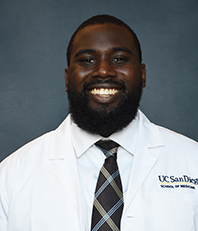
As a medical student at UC San Diego, I reflect daily on the improbable path that brought me here. Born in Ibadan, Nigeria, I came to the U.S. when my mother received a visiting scholarship in Florida. Not long after our move, my grandmother collapsed in our apartment. The speed and coordination of emergency medical care in the U.S. saved her life—something I knew would not have been possible back home. That moment changed me. It planted the earliest seed of my desire to pursue medicine: not just as a science, but as a system of justice.
At Stanford, I built on this early calling. I worked with the Stanford Black Community Services Center to develop a community-based mental health program for African students, and contributed to research on intimate partner violence in the Black church. I also volunteered for several crisis text lines, supporting individuals in moments of acute distress and deepening my understanding of mental health care beyond the clinical setting. Later, I returned to Nigeria for a summer internship, working in a behavioral health hospital and with a local mental health foundation. These experiences taught me that healing does not begin with prescriptions—it begins with trust, access, and cultural humility. I knew I needed a medical education that would nurture both my scientific training and my social vision.
That’s why I joined GHAC. Through the Global Health Academic Concentration, I spent two months in Brasília, Brazil, working in clinics, offering HIV tests to unhoused populations, and learning about SUS, Brazil’s national health system. I was struck by the country’s commitment to universal care. I also found deep commonality between Brazil and the U.S., particularly in how race, poverty, and incarceration intersect to shape access to care. I look forward to furthering my educational journey through the rest of the program.
Whether in Nigeria, Brazil, or the United States, I have seen how systems can either neglect or uplift. I joined GHAC because I want to build systems that do the latter. Through this concentration, I am gaining the tools to become the kind of physician I needed when I was younger—one who sees beyond the chart and into the lives that medicine is meant to serve.

As the daughter of a refugee, I grew up with an acute understanding of the unfair distribution of privilege and pain across the world. I am drawn to medicine because it offers me the privilege of helping and healing my neighbors. I am drawn to the field of global health because it demands collaboration, resourcefulness, and justice. I have a concerted interest in serving refugee and asylum-seeking populations, spanning their entire journey—from displacement to camps to settlement in a new country.
I’ve sought to understand this through scholarship, pursuing an MSc in Social Policy, where I focused my dissertation on barriers to mental health service uptake among asylum seekers in Scotland. I developed an appreciation for co-designed services and participatory methods through my work as a service design researcher in Scotland and a quality analyst at a hospital in Canada.
I am unable to untangle my interests in global health from my desire to be a physician. I chose GHAC because of the unparalleled opportunity to build meaningful, bi-directional relationships with clinical and research teams based in refugee camps early in my career. GHAC will help me translate my values into action, preparing me to lead with humility and advocate for justice as I endeavor to improve systems of care that can truly serve displaced populations.

After immigrating from Ukraine, I grew up partially in a rural region of Lviv, and partially in Philadelphia, PA. I witnessed how medicine was practiced within two substantially distinct frameworks; some portions were complimentary, some identical, and others were completely contradictory. I decided to commit my studies to learning and advancing the “when”, “how”, and “why”, at the intersection of medicine, global health, and economics.
In Ukraine, the Soviet Union’s medical infrastructure remained intact, with a looming paradigm shift aligning with greater anti-corruption regulations. Meanwhile, in the United States, I was encountering a health services sector that was labeled as innovative, well-resourced, and a world standard. I was fascinated concerning the underlying structure of the healthcare systems, so I studied international economics at American University, and at the London School of Economics. After working at the Center for Surgery and Health Economics at the University of Pennsylvania for five years, I realized that I aim to fight for underserved populations on an international scale. However, to actualize this purpose and to truly become a global physician, I first must learn from the people who experience their distinct inequities day-to-day. GHAC provides a balance between essential in-person exposure, and textbook information which provides context for the on-the-ground immersion. I chose the GHAC program, because it directly arms me with the knowledge necessary to make a global, and sustainable, impact as a future physician.

Born and raised in the San Francisco Bay Area, I grew up immersed in the flavors, values, and contrasts of my Chinese and German heritage. Early exposure to global health—watching my physician parents teach and conduct research in Uganda and Guatemala—sparked my desire to understand health beyond the walls of the clinic. That commitment deepened through academic and lived experiences in public health, climate, and community-based research across multiple countries.
Before starting medical school, I earned a Master’s in Population Health Sciences from the University of Cambridge, conducted environmental epidemiology research, and was awarded a Fulbright scholarship to Taiwan, where I taught English and engaged in cross cultural exchange. I also completed a culinary diploma in London, which further reinforced my belief in food as a powerful tool for health, healing, and equity.
I joined the Global Health Academic Concentration to receive structured mentorship in population-based research and to further explore how climate change and social determinants shape health—particularly among vulnerable communities. Looking ahead, I hope to integrate clinical care, public health research, and medical education to serve communities both locally and globally, while advocating for climate resilience and culturally responsive care.

Growing up, I was heavily influenced by the cultures and values of Abiriba, the small village in southern Nigeria that my family immigrated from. Even though I grew up almost 8,000 miles away, my village’s strong sense of family, community, and altruism never left me. Throughout my childhood, I watched my family remain involved in humanitarian efforts that supported the construction of hospitals and schools in Abiriba. Although there is still a long way to go towards eliminating the health and educational disparities that persist there, these experiences showed me how realistic and rewarding it can be to work towards creating healthier living environments around the world.
When I moved to undergrad and had the opportunity to study human biology from a sociopolitical lens, I realized how important it would be for me to work towards creating equitable outcomes in my career as a physician. So, when I applied to medical school at UC San Diego, I was naturally drawn to the Global Health Academic Concentration (GHAC). I knew that my involvement would equip me to engage in discussions of global health disparities and would provide opportunities for me to contribute to the meaningful work that is already being done in the field.
Through my participation in GHAC, I have also realized how important cross-cultural exchange can be for all parties involved. I truly believe that our world benefits when people from different cultures and belief systems exchange knowledge, especially when it is for the purpose of caring for one another. I am hopeful that my involvement in humanitarian medicine will give me many opportunities to serve and learn from people all around the world.

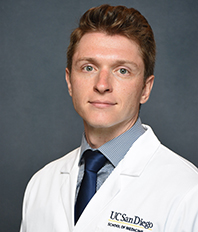
My desire to work in Global Health was brought on by my time abroad in the military. I was pulled into medicine while working with experts in the field of austere healthcare. Their ability to treat life threatening injuries, provide dental work to children, and conduct health check-ups and immunizations within rural communities that lacked access to healthcare opened a door toward medicine and global health. The application of clinical reasoning in the setting of limited resources incentivizes innovation and skill that I was fascinated by and motivated to help overcome. I began to realize that while this resourcefulness was necessary to overcome the hardships faced abroad, it was the inevitable outcome of centuries of inequity that has led to such large disparities among nations. When I discovered UC San Diego’s GHAC program, I was compelled to attend when I learned about the emphasis on sustained, longitudinal partnerships with communities showing that real change comes from long-term collaboration and not fleeting interventions. I see GHAC as the bridge between my military experience and my future as a physician-innovator committed to equity. Through its coursework and global partnerships, I am gaining the framework and mentorship to thoughtfully support health systems and uplift communities around the world.


GHAC & MSTP
My earliest memories are steeped in the steam of chai and the soft murmur of whispered prayers in my family’s kitchen. As the daughter of Afghan refugees, I grew up in a community of migrants where global health was not an abstract concept but a lived reality. I came to understand how access to care, cultural insight, and the social conditions surrounding a person’s life can shape health in profound and deeply personal ways. Those early lessons planted the seed for my lifelong commitment to bridging these gaps. In college, I sought to understand health from as many angles as possible, completing three majors in Biomedical Biology, Public Health Science, and Spanish Studies. This combination of scientific training, public health systems thinking, and cultural and linguistic study taught me that improving health needs more than medical knowledge. It requires context, empathy, and partnership. My path then led me to a Master’s degree in Social Science with a concentration in Anthropology, where I focused on my Middle Eastern and North African (MENA) community, which remains underrepresented and often overlooked in healthcare and biomedical research. Through this journey moving between classrooms, labs, clinics, and community spaces, I saw how lessons learned in one setting could be applied to another, whether across the street or across the world. When I applied to MD/PhD programs, I searched for a place that valued global health not as an afterthought but as a shared responsibility. UC San Diego School of Medicine stood out because of the Global Health Academic Concentration, whose mission closely aligned with my own values and vision for my training. I was drawn to its commitment to pairing intentional and rigorous research with field experiences that meet communities where they are, guided by the belief that real change is built through listening, humility, and trust. I chose this program because my story is not separate from the communities I hope to serve as a future physician-scientist—it is intricately woven into theirs. Through GHAC, I hope to honor that connection and use it as a bridge, transforming lived experience into work that uplifts and empowers the communities that shaped me.

GHAC & PhD
I chose to pursue global health training because I believe that every person deserves the chance to live a healthy life, regardless of their location, nationality, or socioeconomic status. I was drawn to the GHAC program due to its extensive global health network, supportive community, and the program’s dedication to equipping physicians with the skills and experience necessary to carry out ethical and sustainable global health research and clinical work.
My GHAC research experience led me to pursue a PhD in global public health in addition to my MD, where I am currently completing my dissertation work focusing on injury prevention and migration-related morbidity and mortality among migrating populations at the US-Mexico border. My research is informed by my global health experiences during medical school, which have included exposure to a wide variety of cross-border health environments through free clinics, transitional communities of refugees, and clinical experiences in San Diego, El Centro, and Tijuana.
In my future career as a physician scientist, I hope to contribute to the advancement of equitable and high-quality healthcare delivery health both within the United States and across borders, with a focus on improving access and care delivery in border regions and rural areas.
The GHAC program provides the platform and resources to blend clinical medicine, public health, and research in a truly interdisciplinary way, while the GHAC network—its faculty, administrative team, and my fellow peers—serve as an incredible source of support, mentorship, and community throughout the medical school journey.

My path to medicine has been shaped by a deep commitment to global health equity. As a Peace Corps Volunteer in rural Nepal, I taught English and ran after-school health programs—but it was a week-long hospitalization with dengue fever that gave me a firsthand glimpse into the consequences of limited access to care. That experience, along with time spent in Uganda and Colombia, deepened my understanding of how health systems succeed or fall short for those living at the margins.
At UC San Diego, GHAC has allowed me to continue exploring the impact of structural inequities on health. My recent research includes a multinational study comparing quality of life for children with craniofacial conditions in the U.S., Mexico, and Argentina, revealing how cultural context and health system capacity shape patient and caregiver experiences. Through clinical work, community engagement, and global research, I’m committed to building more equitable, responsive systems of care—at home and abroad.
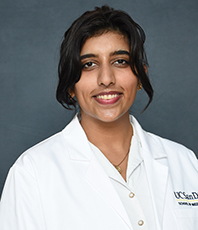

My interest in infectious disease and tropical medicine began during my freshman year at UCLA, when I first learned about Chagas disease. That moment sparked a deep and lasting passion, as I realized this field allowed me to blend my love of microbiology with my desire to connect with people across the globe—while practicing meaningful, patient-centered medicine. At UC San Diego School of Medicine, I was thrilled to join the Global Health Academic Concentration (GHAC), and after my first year, I spent the summer in Ecuador working with Dr. Jose Suarez-Lopez on a study examining the impact of chronic pesticide exposure on adolescent development. That experience not only deepened my commitment to global health but also gave me the research foundation to successfully apply for a grant through the UC San Diego Department of Medicine to study prenatal Chagas disease in Southern California—a project that brought me full circle to the very disease that first inspired my journey into medicine. As I move forward into residency, I remain committed to addressing neglected infectious diseases, both domestically and globally.

Through the socioecological thinking inherent to global health, I aim to integrate traditionally isolated disciplines – such as ecology, public health, medicine, and the political-economy – into cohesive frameworks to co-create solutions to global health issues. Growing up in NYC as the child of Syrian immigrants I witnessed how the confluent effects of migration, geopolitical conflict and the environment shape our health. Since I was young, I have been immersed in many of the forces we name “global health”.
During undergrad, I engaged extensively with migrant justice and education work, helping establish the nonprofit Havenly. I also helped conduct sexual health research and project implementation in Lebanon. In medical school, my involvement in planetary health focused on studying the effect of secondary exposure to pesticides in adolescents and children living in a rural community in Ecuador. As a medical student in San Diego, I continue my passion for migrant justice through migrant health projects.
I am excited to center global health in my training and career precisely because it recognizes and addresses these forces. I am interested in decolonial global health practices that challenge paternalistic benefactor-beneficiary dynamics in global partnerships. Within global medicine, I am passionate about planetary and environmental health, infectious diseases/neglected tropical diseases, and LGBTQIA+ health.

I’m so happy to be continuing my global health education at UC San Diego, the very institution that introduced me to this field as an undergraduate student and where I have spent nearly a decade developing a passion at the intersection between global health and medicine. I was thrilled to join GHAC as it offers a strong, focused formal education for future physicians that is rooted in the foundational tenets of global health. After my first year of med school, I spent my summer in Brazil where I not only conducted research on Tuberculosis but also rotated on several inpatient services including Infectious Disease and Cardiology. The time I spent as a part of a medical team in Brazil deepened my understanding of the importance of international collaboration in medicine and ultimately inspired me to start a multi-national research project examining how different cultures shape medical education.
One of my goals as a future global health physician is to draw attention to diseases that are largely ignored by the global north but still imbue an enormous burden on healthcare systems worldwide. I am also interested in critical care medicine and hope to serve in disaster settings, providing care to those affected by war, displacement, or natural disasters. I’m so excited to see where GHAC takes me this year for part 2!

Growing up, I was influenced by the global perspective of my parents, who met through the Peace Corps in a small village in The Gambia. This background emphasized the central important of service and an awareness of the interconnectedness of the modern world. As I began my training, I wanted the expertise and skills I gain through medicine to benefit people from the communities I consider myself a part of—including those in Sub-Saharan Africa and across the Global South. This context led me to apply to the GHAC program at UC San Diego.
Before coming to UC San Diego, I was fortunate to have international work experiences which complicated my view of globalization and further strengthened my interest in medicine. Through GHAC, I have been privileged to have dedicated space to engage in thoughtful dialogue and critical analysis of the history, complexities, and ethical challenges inherent in global health practice.
This program provided many opportunities to learn from physicians who integrate international collaboration into their clinical and academic work to make a positive impact. Ultimately, GHAC offers me a unique platform to explore the history of international health and to thoughtfully envision my own ethical role and contribution in global health settings.

I grew up in Nepal and moved to the U.S. during high school. As an undergraduate at UC San Diego, I began volunteering at Jacobs Medical Center, which was my first experience in an American hospital. I was struck by the differences in healthcare delivery between the U.S. and Nepal, and I realized that my background gives me a unique perspective on global health. I hope to apply this perspective to global surgery.
Surgery requires advanced tools and technical training, but it also relies on skill, innovation, and knowledge-sharing. I am passionate about strengthening surgical capacity in low- and middle-income countries by supporting programs that foster sustainable, independent surgical centers. Equally important, I believe in the bidirectional exchange of knowledge: while high-resource centers can provide specialized training, surgical centers in low- and middle-income nations can often teach us how to deliver effective care with limited resources.